 AtomOne Wallet
Windows
Version 2.1.4
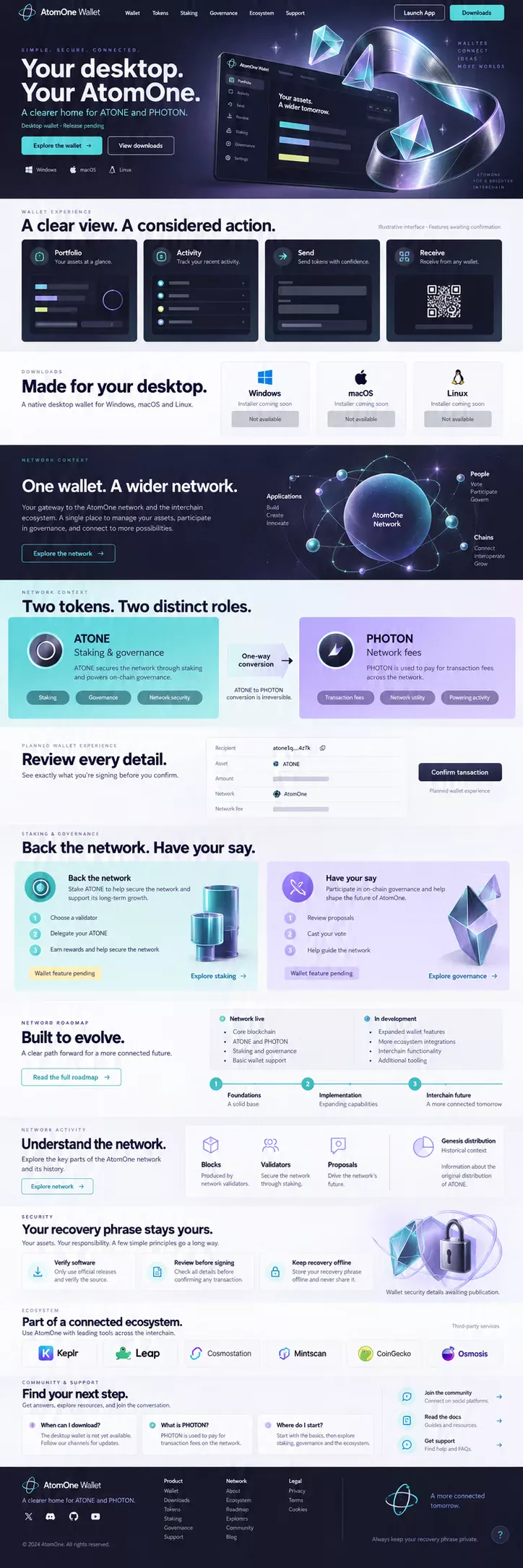
Simple. Secure. Connected.
A clearer home for ATONE and PHOTON.
A desktop wallet for the decentralized AtomOne network. Understand ATONE and PHOTON, explore network tools and take part in a community shaped by its participants.
For Windows, macOS and Linux
Downloads
A desktop wallet for Windows, macOS and Linux.
Version 2.1.4
Version 2.1.4
Version 2.1.4
Wallet experience
Understand everyday account activity: balances, transfers, receiving and transaction history. Clear information supports independent decisions.
Separate assets. Clear roles.
ATONE and PHOTON serve distinct roles. Keep available balances separate from bonded stake when reviewing an account.
Follow the account story.
Trace each action through its transaction hash and network status. Submission and block confirmation are distinct stages.
Review before signing.
Review the recipient, asset, amount and fee together. Confirm the full address and any required memo before signing.
A public address, ready to share.
Public address · AtomOne
Share the receiving address, then confirm the network and asset with the sender. Recovery information is never needed to receive funds.
AtomOne Wallet brings a desktop focus to the AtomOne ecosystem across Windows, macOS and Linux. Explore the assets, network tools and principles of participation.
Decentralization depends on informed participants. Learn how delegation supports validators, how stakers shape governance and how PHOTON pays network fees.
Wallet guideNetwork context
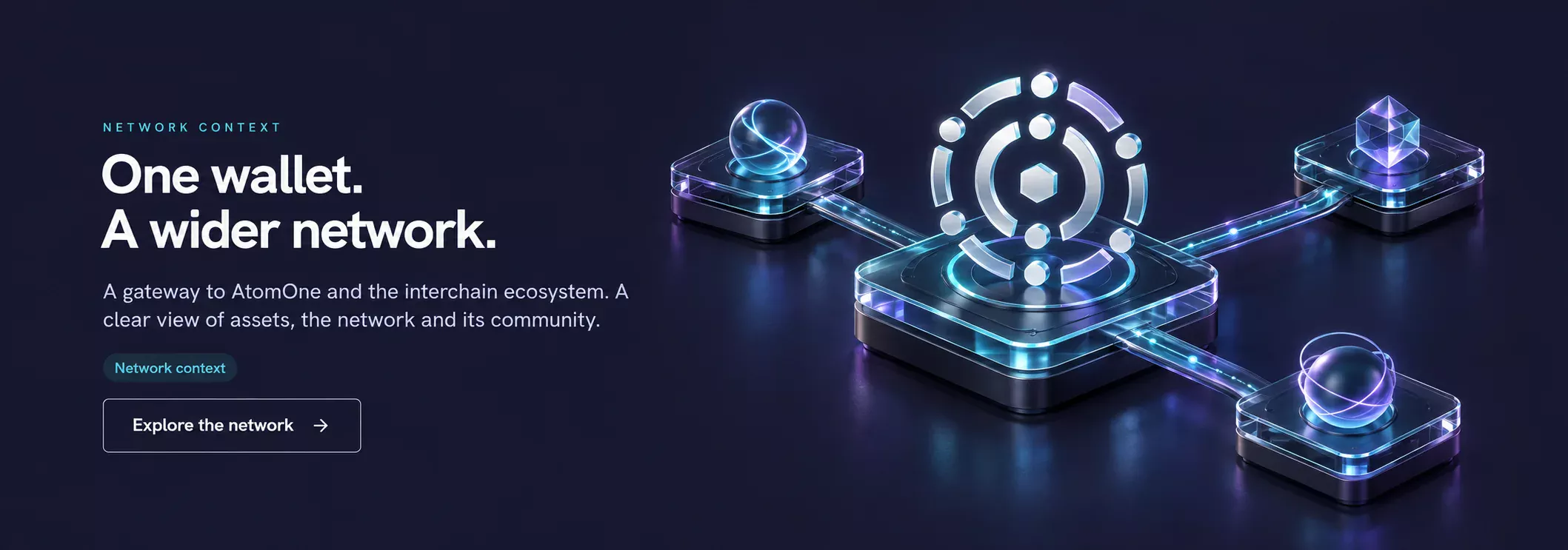
A gateway to AtomOne and the interchain ecosystem. A clear view of assets, the network and its community.
AtomOne began as a community-driven fork of the Cosmos Hub. It is a separate blockchain with its own ATONE token, address prefix and governance rules.
Validators produce blocks and delegators back them with ATONE. Staking and on-chain governance give the community distinct ways to participate in the network.
IBC is the Cosmos protocol for communication between chains; ICS extends shared security. The network roadmap explores how these protocols extend connections between independent chains.
Network context
Staking & governance
ATONE secures the network through staking and powers on-chain governance.
ATONE to PHOTON
conversion is irreversible.
Network fees
PHOTON is used to pay transaction fees across the AtomOne network.
Staking, voting and paying fees serve different purposes. The two-token model makes that distinction explicit.
Delegated ATONE contributes to network security, while staked ATONE carries governance voting power. ATONE is the native asset of AtomOne; it is distinct from Cosmos Hub’s ATOM.
A spendable balance and a staked balance are different: bonded tokens follow staking and unbonding rules before they can be transferred.
PHOTON is the network’s dedicated fee token. Before submitting an action, review the fee denomination and amount shown by the signing tool and leave enough available to cover it.
A token balance alone does not explain whether a transaction can proceed: available fee tokens matter too.
Minting PHOTON burns ATONE. The protocol cannot reverse that burn, and the amount minted depends on network supply rather than a fixed exchange rate.
Read the current estimate before signing. A market price for ATONE is not an ATONE-to-PHOTON minting quote.
Network references: AtomOne FAQ and PHOTON introduction.
Transaction essentials
Every signature is a decision. Review the recipient, asset, amount, network and fee together before authorizing a transaction.
Review these five essentials before authorizing a transaction on a decentralized network.
Compare the full recipient address with the intended destination. AtomOne addresses use the atone1… prefix; a familiar name alone is not enough.
Confirm which token is being moved and the exact amount. Treat a transfer, a delegation and a burn as different actions.
Check that the action is intended for AtomOne. Similar token names or account labels can appear on different chains.
Review the fee shown by the signing tool. If a destination requires a memo, obtain it from that destination and check it before sending.
Keep the transaction hash. An explorer can show whether the action was included in a block; a submitted transaction is not the same as a confirmed one.
Authorize transactions in the signing application. This website explains the process and never requests private keys or recovery information.
Staking & governance
Stake ATONE to help secure the network and support its long-term growth.
Participate in on-chain governance and help shape the future of AtomOne.
AtomOne combines validator-backed consensus with direct staker participation. Understand delegation and governance before taking part.
Look at commission, reliability and participation, rather than choosing only by a displayed reward rate. Delegation backs the validator’s contribution to consensus.
Delegation bonds tokens to a validator. Check the validator, amount and fee together before signing.
Rewards depend on network conditions and validator commission. Validator faults can lead to slashing, so returns are not guaranteed.
Redelegation changes validators subject to network rules. Undelegation starts an unbonding period; tokens are not immediately available for transfer.
Read current network parameters before delegating. The guide does not quote a fixed yield or unbonding duration.
Review the full text, requested change and community discussion. The on-chain Constitution provides the framework for network decisions.
A submitted proposal may need sufficient deposits before voting begins. Check its current status and the applicable deposit rules.
Eligible stakers participate directly. Read the available voting options and the deadline shown by the governance tool before signing.
After voting ends, inspect the recorded result and any follow-up implementation. A discussion, a passed proposal and a completed change are different stages.
Voting periods and thresholds are network parameters. Check their current values on the proposal being reviewed.
Network roadmap
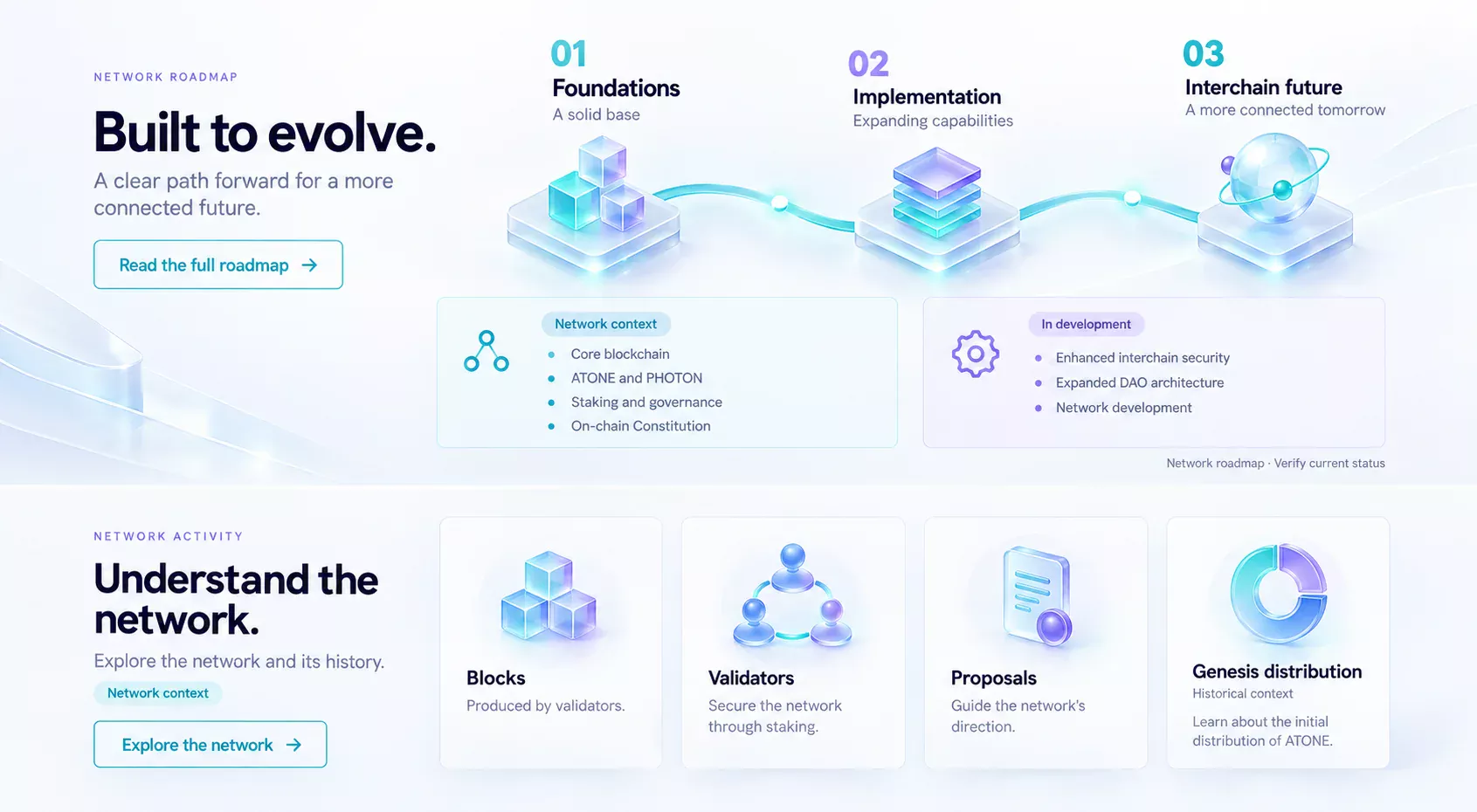
The network roadmap moves from founding documents and chain launch to governance, validator design and interchain development.
Explore the foundations of the chain, its governance priorities and its direction within the interchain. Network evolution is shaped through community participation.
Learn to read the networkChain launch, founding documents and the initial token allocation.
PHOTON mechanics, governance improvements and DAO development.
Validator incentives, expanded shared security and cross-zone governance.
Explore the network foundations and the priorities described in the AtomOne roadmap. Network roadmap source ↗
Network activity
Read activity in context: blocks record transactions, validators maintain consensus and proposals record governance decisions.
These explanations help interpret an explorer. This section does not display a live feed or current network statistics.
Validators group transactions into blocks. A block height and transaction hash help locate a particular action in the chain’s history.
Validators operate the network’s consensus nodes. Delegation backs their stake; commission and operational reliability matter when comparing them.
On-chain proposals record requested changes, deposits, votes and outcomes. Read the full proposal and its current stage before participating.
ATONE’s initial allocation was approved by the GovGen community. Genesis allocations describe network history, rather than present balances or wallet users.
Security
Understand what can be shared, what must stay private and what to check before installing or signing.
Download only verified releases and check the source.
Check the destination, asset, amount, network and fee before confirming.
Store recovery information offline. Never share it with a website or support chat.
Account security starts with private keys, trusted software and informed signatures.
Use the Downloads section for Windows, macOS and Linux. Verify the source of any software and follow its installation and integrity-check instructions.
After installation, open the desktop app directly from the operating system. The browser cannot confirm that an app is installed.
Explore downloadsA public address can be shared to receive assets. A recovery phrase or private key gives control of an account and must stay private. Never enter either in this website, a support conversation or an unexpected form.
Store recovery information offline. Read signing requests carefully, especially when a third-party application asks to connect or approve an action.
Review key storage, encryption and signing methods for every application used. Network consensus and account security are distinct layers of protection.
Ecosystem
Explore network applications, independent wallets, explorers and market tools, grouped by what they do.
A decentralized ecosystem brings together independently operated applications and services. Explore each resource and review its permissions before connecting.
AtomOne network applications
Delegate, redelegate and undelegate ATONE.
Network application listed by AtomOne.
AtomOne network applications
View proposals, vote and deposit.
Network application listed by AtomOne.
Compatible third-party wallets
Browser-extension and mobile wallet for Cosmos chains.
Independent wallet supporting AtomOne.
Compatible third-party wallets
Cosmos-focused wallet for browser and mobile.
Independent wallet supporting AtomOne.
Compatible third-party wallets
Multi-chain Cosmos wallet.
Independent wallet supporting AtomOne.
Blockchain information
Block explorer: transactions, validators, proposals.
Independent explorer indexing AtomOne.
Markets and analytics
Market data aggregator.
Independent data site.
Markets and analytics
Market data aggregator.
Independent data site.
Markets and analytics
Decentralized-exchange market data.
Independent data site.
Trading and liquidity
Decentralized exchange in the Cosmos ecosystem.
Independent DEX listed in the AtomOne ecosystem.
Infrastructure and communication
Communication tool listed in AtomOne's ecosystem.
A communication resource in the AtomOne ecosystem.
Other reference tools
Community tooling related to PHOTON.
Community resources for understanding PHOTON.
Review each service’s permissions and signing requests. A market price is separate from a wallet balance or PHOTON minting estimate.
Community & support
Installation, assets, signing and participation: open a question to read the full answer without leaving this page.
The desktop platforms are Windows, macOS and Linux. The Downloads section lists the version for each platform.
AtomOne Wallet is a desktop wallet for the decentralized AtomOne ecosystem, with a focus on ATONE, PHOTON and informed network participation across Windows, macOS and Linux.
No. The website works on phones, but the wallet is for Windows, macOS and Linux only.
It's meant to hand off from the website to the installed desktop app. Browsers can't detect installed apps, so if nothing opens, open the app directly on your computer.
AtomOne has two native assets: ATONE for staking and governance, and PHOTON for transaction fees. Each has a distinct role in the decentralized network.
ATONE is AtomOne's native staking and governance token. It's delegated to validators to secure the network and gives voting power on proposals. It is not the same as Cosmos Hub's ATOM.
PHOTON is AtomOne's fee token. It's minted by burning ATONE in a one-way process — it can't be turned back into ATONE. Maximum supply is 1 billion PHOTON; 1 PHOTON = 1,000,000 uphoton.
It varies. The rate depends on how much PHOTON already exists versus the ATONE supply, so each burn yields a little less as PHOTON supply grows. Check the current estimate right before you confirm.
You delegate ATONE to a validator. Delegation can earn rewards and carries slashing risk. Undelegating starts an unbonding period during which tokens are locked. The AtomOne Staking dApp supports this today.
Staked ATONE gives voting power on on-chain proposals. The AtomOne Governance dApp lets eligible users view proposals, vote and deposit. Its FAQ describes a two-week voting period.
Never share it. No legitimate support team will ever ask for your recovery phrase or private key. Treat any such request as theft.
Look up the transaction hash on a block explorer such as Mintscan. Check you had enough PHOTON for the fee.